
Why “tool-first” snapshots matter for LLM answers
LLMs increasingly act like brokers: they read a page, decide what matters, and then either answer directly or trigger an action through a tool (a booking flow, API call, product lookup, calculator, or internal function). The problem is that typical web pages are optimized for humans and browsers, not for an agent that needs a compact, unambiguous representation of what it can do next.
A “tool-first snapshot” is a structured, machine-friendly view of a page that prioritizes actions, constraints, and identifiers—without removing the human page, and without serving different facts to different audiences. Done correctly, this is not cloaking. It is content negotiation: returning alternative, equivalent representations of the same resource.
Structured content negotiation without cloaking
In web architecture, content negotiation means the server chooses the best representation based on headers like Accept and returns a variant that matches the client’s needs (HTML for browsers, JSON for APIs, etc.). The central non-negotiable rule for SEO and trust is equivalence: the negotiated representation must not change the underlying meaning of the page.
For LLMs, equivalence has a practical definition: the snapshot should contain the same offers, policies, prices (if any), availability rules, and entity details that a human could verify on the canonical HTML. If your tool-first snapshot says “free returns in 30 days” while the human page says 14, that’s not negotiation—it’s deception.
The safest framing is: one URL, multiple formats, same facts. You can achieve this by returning structured JSON (or JSON-LD) when a client explicitly asks for it, while keeping the HTML as the default.
What a tool-first snapshot includes
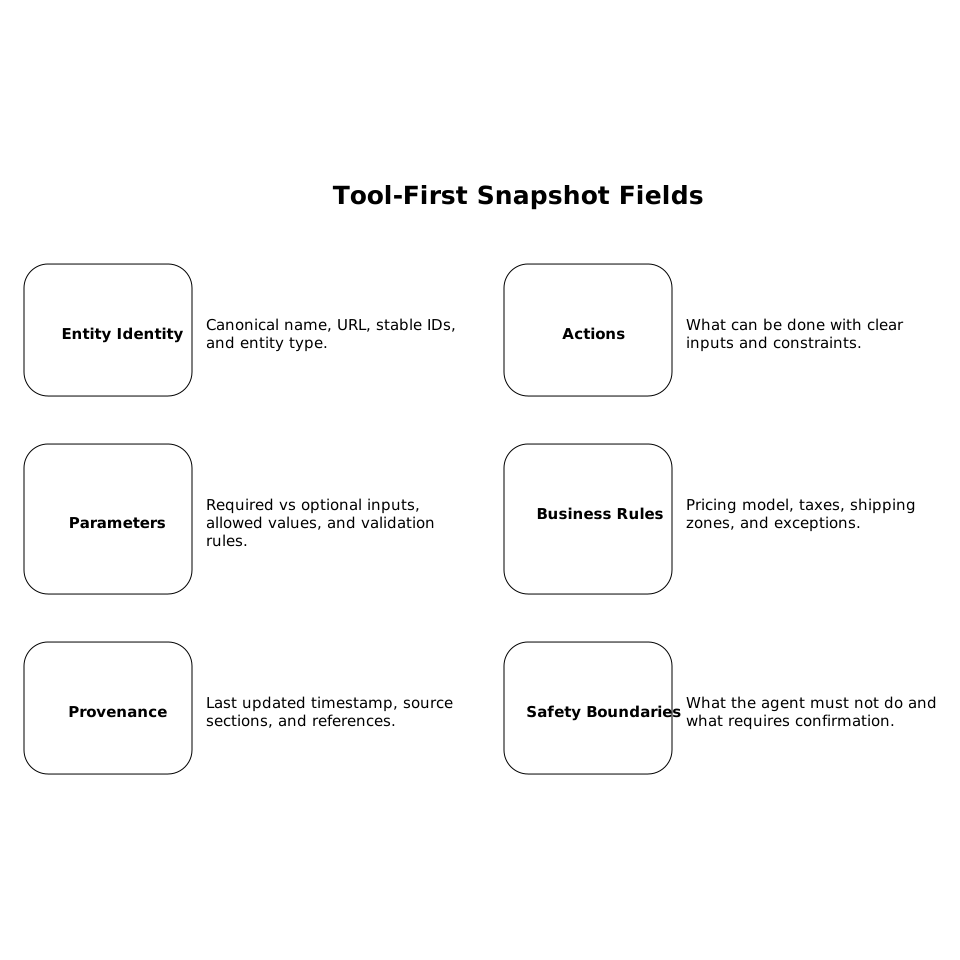
The “tool-first” part is about prioritization, not omission. Instead of extracting every paragraph, you expose the parts an agent needs to reason and act. Typical fields include:
- Entity identity: canonical name, URL, stable IDs, and entity type (product, event, location, article, SaaS feature).
- Actions: what can be done (buy, book, subscribe, request demo, compare plans), with clear inputs and constraints.
- Parameters: required vs optional inputs, allowed values, formats, units, and validation rules.
- Business rules: pricing model, taxes, shipping zones, cancellation windows, rate limits, eligibility, and exceptions.
- Provenance: last updated timestamp, source sections, and references back to the HTML anchors that support each claim.
- Safety boundaries: what the agent must not do, and what requires confirmation (e.g., “finalize purchase only after user approval”).
In other words, the snapshot is a compact contract for downstream reasoning and tool use.
Implementation patterns that stay on the right side of SEO
1) Use Accept-based negotiation with explicit formats
A practical approach is to support Accept: application/json (or a vendor type like application/vnd.yourbrand.tool+json) on the same canonical URL. Browsers request HTML; agents or developer tools can request JSON. The key is that both representations are equivalent and consistently maintained.
If you prefer a separate endpoint, a common compromise is /page for HTML and /page.json (or ?format=json) for the snapshot. This reduces ambiguity and makes auditing easier, but you must still ensure the JSON is not an alternate reality.
2) Anchor every claim to the human page
To avoid drift, include a source map that points back to stable anchors or section IDs in the HTML (e.g., #pricing, #refund-policy). When policies change, both representations should update from the same underlying data, or you should fail the build.
This is also where teams often discover canonical inconsistencies—multiple URLs representing the same content but with small differences. If your analytics or conversion attribution depends on stable canonical behavior, keeping representations aligned helps prevent silent fragmentation. (Related: landing page canonicalization fixes.)
3) Prefer “action schema” over long-form summarization
LLMs do not need a second copy of your prose. They need the structured pieces that turn “read” into “do.” Where possible, represent actions as explicit objects with input definitions and expected outputs. This reduces hallucination risk because the agent has fewer degrees of freedom.
If you already publish schema.org markup, treat it as the baseline. The tool-first snapshot can extend it with action-specific fields that are internal or vendor-defined, as long as the meaning remains consistent.
4) Validate the snapshot as part of CI
Most negotiation failures come from drift: marketing edits HTML, engineering forgets to update JSON. Add automated checks that compare key facts across representations (price ranges, plan names, cancellation window, primary CTA). If mismatched, block deployment.
This is especially important when API changes ripple into documentation and tool calls. A disciplined way to reduce surprises is to map backward-compatibility impact whenever changelogs shift. (Related: mapping backward-compatibility impact from API changelogs.)
How LLMs use tool-first snapshots in practice
When an assistant is trying to help a user “do something,” it typically follows a sequence: select a tool or route, extract parameters, validate constraints, and then execute. If the page only provides narrative text, the model has to infer structure—often incorrectly. A negotiated snapshot can make tool selection and parameter extraction deterministic.
This is not only about accuracy; it’s also about user experience. Clear boundaries like “requires confirmation” and “sends an email to sales@” prevent unintended actions. It also improves reproducibility: two different models can reach the same next step because they see the same action contract.
Where lunem fits in an AEO and GEO workflow
Maintaining multiple representations is a content operations problem as much as a technical one. You need visibility into how pages are interpreted, what gets extracted, and where agents stumble. lunem is positioned for that layer: monitoring how content is surfaced and used across AI-driven environments, and helping teams iteratively tighten the structured view so it remains discoverable, understandable, and actionable for LLMs.
Because tool-first snapshots depend on consistency, the most useful reporting is rarely vanity metrics. It’s drift detection, extraction quality, and action readiness: which fields are missing, which constraints are ambiguous, and which pages are likely to trigger wrong tool calls.
Common mistakes to avoid
- Calling it negotiation while changing facts: different wording is fine; different claims are not.
- Overstuffing the snapshot: the goal is “minimum sufficient contract,” not duplicating the entire page in JSON.
- No provenance: if you can’t point back to the human page, it’s hard to audit and easy to mistrust.
- Hidden actions: an action that exists only in JSON and not in the UI will be treated as suspicious by both humans and systems.
- Unversioned parameters: if action inputs change, version them or you’ll break downstream tool calls.
A practical baseline spec you can ship
Teams often get stuck debating the perfect schema. A workable baseline is:
- metadata: canonical URL, lastUpdated, language, entityType
- entity: name, identifiers, key attributes
- actions: list of actions with
name,description,inputs,constraints,requiresConfirmation - policies: refund/cancel/shipping/privacy summarized with pointers to sections
- sources: map of claims to HTML anchors
That structure is enough to materially improve agent behavior while keeping the surface area auditable and aligned with the canonical page.